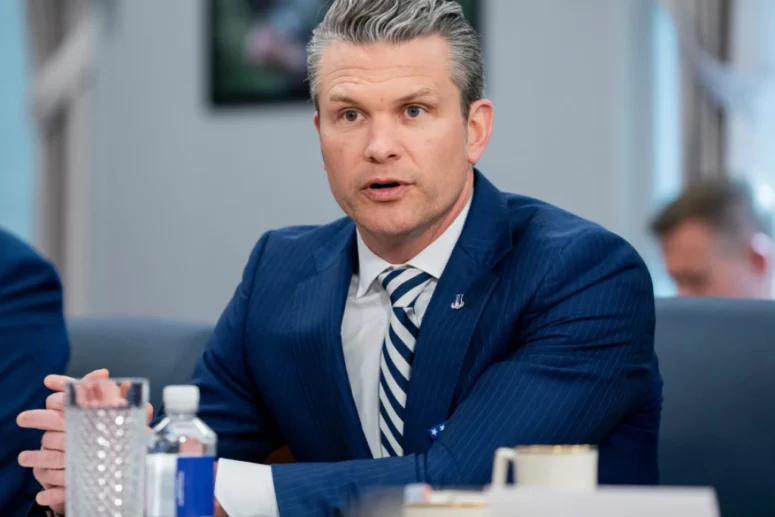
Pentagon chief Peter Hegseth assured allies in the Indo-Pacific at a security conference in Singapore that they would not be left alone to face growing military and economic pressure from China. He said Washington would strengthen the Pentagon's defenses abroad to counter Beijing's rapidly evolving threats, particularly its aggressive stance toward Taiwan. Hegseth said the threat posed by the Chinese military was real.
The head of the Chinese delegation dismissed the US defense secretary's statements as baseless. Hu Gangfeng, vice president of the National Defense University of China, said: "Some of the allegations are completely fabricated, some distort the facts. These actions are nothing more than attempts to create trouble, incite division and conflict in order to destabilize the Asia-Pacific region."
Western military experts believe that China could seize Taiwan by force by 2027, if necessary. China has also built sophisticated, artificial islands in the South China Sea to support new military outposts and developed highly advanced hypersonic and space capabilities that have prompted the United States to create its own space-based “Golden Dome” missile defense systems.
Speaking at the Shangri-La Dialogue, a global security conference hosted by the Institute for International Security Studies, the Pentagon chief said China is no longer building up its military to take over Taiwan, but is “actively training for it every day.” Hegseth also touched on China’s ambitions in Latin America, particularly its efforts to increase its influence over the Panama Canal. He called on Indo-Pacific countries to increase their defense spending to a level closer to 51% of their gross domestic product.
Hegseth also reiterated previous administrations’ pledges to bolster the U.S. military in the Indo-Pacific. While both the Obama and Biden administrations pledged to pivot to the Pacific and create new military alliances throughout the region, a full shift has never materialized. In the past few months, the Trump administration has pulled a Patriot missile defense battalion out of the Indo-Pacific to deploy to the Middle East, launched a massive logistics operation that required 73 military cargo flights, and sent Coast Guard ships back to the United States to help secure the U.S.-Mexico border. Hegseth was asked why the U.S. had pulled these resources if the Indo-Pacific was a priority theater. He did not directly answer the question, but said the shift was necessary to bolster defenses against Houthi missile attacks from Yemen and to protect the United States from illegal immigration. At the same time, he stressed the importance of America's allies and partners strengthening their defense spending and preparations.
 EN
EN  AZ
AZ  RU
RU  TR
TR